ChefClaude
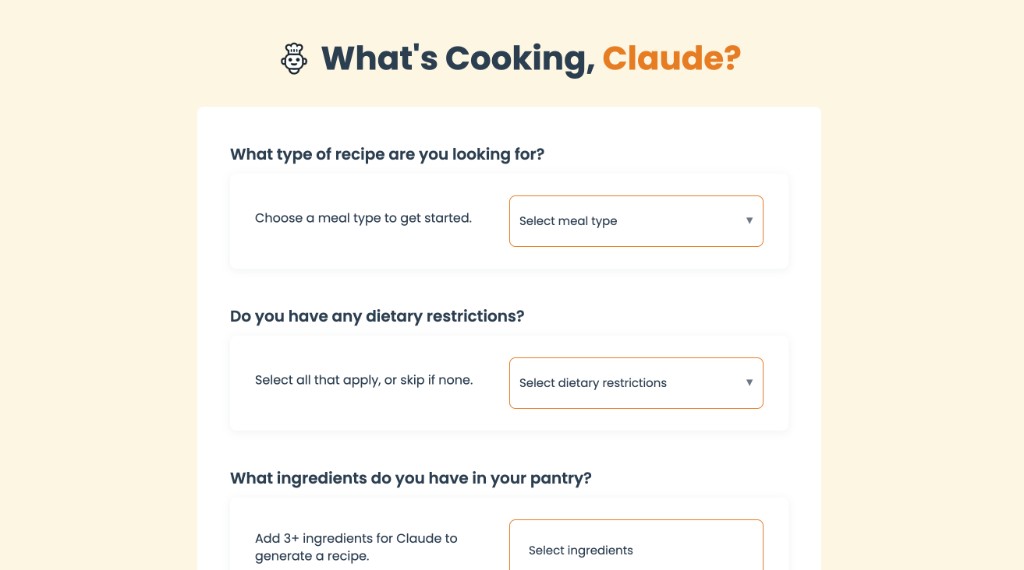
In the spring of 2025, I started getting FOMO about AI. Everyone was talking about it, and I wanted to join the club. I decided to take small steps by building a web app for cooking up recipes from whatever was sitting in my pantry. This is the story of my early journey of experimenting with vibe coding tools, and how I've developed a framework for prompt-based frontend development that works for me.
Stage 1: OMG, this can do everything? Wow!
I started experimenting with the free plans on Lovable and Cursor, throwing some prompts at it to see what would happen. It did a fairly good job, and I felt scared about how good it was at building things. I was writing vague prompts and letting AI run with whatever it interpreted and it mostly built what I wanted. I was so amazed by the output that I wasn't even really thinking about the specifics of what was being built in front of me. I started wondering if my career was over. Were we all "cooked"? The LinkedIn posts were getting too real for me.
Stage 2: "Oh.. wait. We've got some work to do here"
I took some time away, and came back to my prototype after deciding to give things another shot. I realised that AI had taken lots of liberties and built something which did the job…but that was it. I wanted more. So I started over, and this phase taught me so many new things —
Be thorough and know what you want
I went back to my user needs, user roles, user workflow maps (the UXR in me was coming out). I really thought deeply about what I was doing, and used my new paid Claude subscription to build out a detailed PRD for my web app. I then asked Claude to give me a detailed prompt for what I wanted to build, and pasted that into Cursor. The results looked good! Quite similar to what I was envisioning. I was happy. :-)
Small but detailed prompts > one big vague one
A few days later, I looked at my code and realized it was quite… messy. My previous SWE training pushed me to rename my CSS in BEM format and componentize the code to make it reusable. I'd also felt slightly uncomfortable asking Cursor to do many many things for me in one go since it almost felt like I was losing grip on my own work. So I wrote smaller but detailed prompts, and achieved the cleanup and refactor in minutes.
Plan mode is helpful for structuring my thoughts
I started experimenting with it to help me add smaller features (like dietary restriction filtering) and to fix UI bugs. It was helpful since it acted like an experienced buddy who went out, did the research, and came up with a plan.
Figma still has a place in my process
I probably should've thought about visual design earlier, but I got too excited about building the app out and making it work. When the time came to make it more visually polished, I noticed that prompting wasn't helping. Why would I want to describe in words a goal that can be achieved by changing a few lines of CSS? Slowly though, I realised that doing these changes directly in code wasn't efficient either. Having an idea of how I want something to look by designing it in Figma first, and then translating it into CSS, was more efficient. Prompting helped with big picture styling, but the granular decisions were better made in Figma, where I could see the results and experiment more freely. I'd probably use code for more dynamic design details like animations, non-deterministic outputs, etc, but for plain old design variations, Figma works quite well for me so far!
Stage 3: Yay! AI works well for me when I know what I want
This is the fun part. I now knew the basics of what worked for me, and I could use AI to assist me in achieving my UI goals more effectively. I added multiple new enhancements, and was pleased with the results. By this time I'd also started getting better at reviewing my code and fixing anything that looked off right away. This prevented annoying errors from creeping in when unexpected. I was also not really blind vibe coding, but more like asking AI to do tasks for me in technical terms. I knew the codebase. I was confident about what I was asking for, and did not feel nervous about vibe coding. AI was feeling more like a buddy that was doing the boring syntactical work for me, while I did the thinking and deciding of how and why I want to do things.
Now
I've recently been experimenting with the Figma MCP, and I'm exploring how to prompt more effectively; maybe even creating shareable prompts that others can use too. I want to keep getting better at leveraging Plan mode in future projects.
More than anything, this whole project has made me feel excited about what's possible. I'm a UX/dev/PM hybrid who likes to build things that help people, and this project has made me feel more empowered to work on projects without having to choose between roles. :)